Remote Work: Impacts on Cities and Policy Responses
Contact: Anastasia Loukaitou-Sideris: [email protected]
Emergence and Proliferation of Remote Work
Since the industrial revolution, the private realm of the home has been radically separated from the public realm of work, especially in Western industrial societies. But in more recent years, these rigidly separated boundaries between home and work have become more blurred. Remote work (also called ‘telework’ or ‘telecommuting’ when enabled by telecommunications technologies) has grown exponentially in the past decade. In addition to the proliferation of smart phones and portable computers, technological advances such as digital whiteboards, videoconferencing, and collaboration and communication apps have allowed employees all over the world to work remotely from home, or even from anywhere at any time. As a result, more people are working at home, on the train, at co-working spaces, libraries, and coffee shops, and the use of these remote-work options has been steadily rising.
In contemporary times, the origins of remote work date back to the 1970s and 1980s, as an option that reduces commuting trips and dependence on transportation services (Mohktarian, 1991) by offering alternative sites for work, such as one’s home, satellite offices, or neighbourhood telework centres (Gurstein, 2002). Working from home (WFH) coincided particularly with a futuristic vision of the white-collar labour force working in home offices (Pratt, 1984) and was associated with the start of declining costs in data communications and the influx of personal computers in homes and offices. The motivation for WFH was related to energy shortages, the willingness to decrease daily commuting, and a desire to improve the integration of mothers in the labour market. During the first decades of the 1980s and 1990s, the typical workers from home were freelancers, mainly full-time clerical women seeking income at reduced personal expense; managerial and professional mothers wanting to nurture young children without dropping completely behind in their careers; and male managers or professionals who valued the part-time integration of work and family life more than their career advancement (Pratt, 1984).
Since the 1980s and 1990s, a number of conditions have affected the white-collar labour market and further boosted opportunities for remote, more flexible work patterns. These include: a significant increase of information-based and service occupations, contract work, and part-time employment; an ever-increasing accessibility and advancement of telecommunication services and equipment; and a higher sensitivity to need for improved work-family life balance (Gurstein, 2002).
In the final months of 2019, an unexpected event – the emergence of the COVID-19 pandemic – made remote work inevitable for many workers. The pandemic resulted in community lockdowns and stay-at-home mandates around the world. In addition to government mandates, the fear of contagion led most people to stay home, while offices, schools and universities moved completely to remote work to avoid their employees’ and students’ exposure to the disease. The pandemic brought an unprecedented large-scale shift in the labour market towards working from home (WFH) (see figure 1). This was particularly true for higher income, better educated, white-collar individuals, than lower-income front-line employees (Malik et al., 2022).
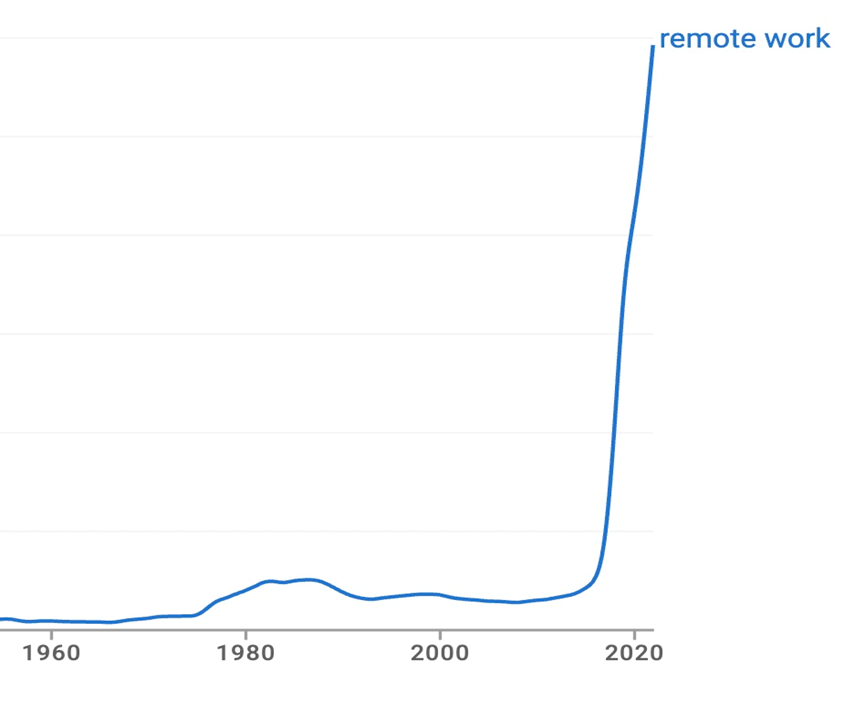
Figure 1. The use of the term ‘remote work’ over the last decades, showing a huge peak c. 2020–2021. (Source: Google Ngram Viewer)
In the post-pandemic era, while remote work has plummeted from its pandemic high, and a number of companies have moved away from their telework initiatives, remote work is still significantly higher than its pre-pandemic levels (Šmite et al., 2023). In the European Union, the mean percentages of home-based teleworkers in the twenty-eight member states were only 5 per cent in 2000. By 2024, this percentage had almost doubled to 9.9 per cent. Among the member-states, Ireland (20.6 per cent) and Finland (19.6 per cent) have the highest percentage, while Romania has the lowest percentage of teleworkers (1.2 per cent) (Galan, 2025). Cultural variations among member-states appear to play a significant role in these differences. More specifically, in north-European countries telework is a better-established practice than in south-European countries.
In the US, 29 per cent of households had someone working from home at least one day per week in 2023 (U.S. Census Bureau, 2023). Concentrating only on federal employees in the US, a report by the U.S. Office of Personnel Management found that telework eligibility among employees had continued its year-over-year increase reaching 57 per cent in fiscal year 2023 (OPM, 2024). But this trend has been upended by the current Trump administration, which has mandated that all federal employees work in-person.
In addition to those working from home, fully or partly, two other categories of teleworkers have also emerged: (a) ‘nomadic teleworkers’ and (b) ‘over-time teleworkers’. ‘Nomadic teleworkers’ are individuals teleworking from places other than offices – e.g. on trains, in airports, in the clients’ premises, in holiday resorts, in coffeeshops, etc. – helped by the development of mobile information and communication (ICT) devices, especially portable computers and mobile phones. On the other hand, ‘over-time teleworkers’ are individuals teleworking from home outside the normal working hours (early in the morning, late at night, during weekend, etc.).
In the ΙT industry, global players such as Facebook and Microsoft have made revolutionary announcements of new remote work policies and opened remote positions. Twitter, Salesforce, and Spotify have made further steps introducing permanent ‘work-from-anywhere’ positions and distributed first policies based on the forced WFH experiences during the pandemic (Stoller, 2021). On the other hand, Apple has struggled with returning to the conventional close to full time office work (Zetlin, 2021) and, as already mentioned, the Trump administration has mandated that federal employees in the US come back to their offices. The most common practice today is that companies implement WFH as an element of flexibility, leading to a regular but partial ‘hybrid’ practice (some days of the week in the office, some days working from home).
Overall, WFH tends to be favoured by many employees and is often perceived as a catalyst associated with job satisfaction and quality of life. Of course, there are disadvantages also reported by employees such as: (a) not everybody feels equally productive working from home; (b) work hours for many have increased; (c) physical activity, socialization, pairing, and opportunities to connect with unfamiliar colleagues have decreased; and (d) information sharing and meeting patterns have also changed (Šmite et al., 2022). However, on the basis of major advantages such as flexibility, elimination of commuting time and cost, and better perceived compatibility with family life, an increasing number of companies worldwide are adopting WFH policies, indicating that remote work is likely to be a long-term trend in the labour market.
Impacts of Remote Work on Cities
The gradual increase of telework and hybrid work in the next decades is of concern for both policymakers and academics. According to a report published by Eurofound (an EU foundation that is concerned with the improvement of living and working conditions), different scenarios are set to be taken into consideration by EU Authorities drafting new legislation and regulation to ensure job quality. These scenarios outline alternative directions that telework and hybrid work might take under different conditions. Some of these conditions may be under the control of policymakers and organizations, while others, such as external events and crises, are not (Demetriades et al., 2023).
For academics in the field of urbanism (architects, urban designers, urban and spatial planners), another important concern, which remains relatively understudied, is the socio-spatial and economic effects of remote and hybrid work on cities and the development of good planning and design to accommodate the new trends. Indeed, key research questions can be raised about the impacts on the metropolitan landscape, its city centres, inner-city neighbourhoods, suburbs, peri-urban, and rural areas.
A strong scenario seems to be emerging that large-scale telework, in combination with other trends (for example, the proliferation of e-commerce), would lead to a decrease in the need for large office spaces for private enterprises in city centres, thus, creating a surplus of vacant spaces and buildings there. In fact, this scenario is currently being experienced by a number of US downtowns – including those of Los Angeles, San Francisco, and Austin – which are currently experiencing high office vacancies (Kotkin, 2025). A number of questions arise:
-
How will the surplus of vacant spaces and buildings in city centres affect the real estate market, and especially, the office real estate?
-
What kind of businesses will move into the abandoned spaces in city centres?
-
What are appropriate adaptive reuse processes for the currently empty office buildings in city centres?
-
Will the economic identity of city centres shift away from the FIRE economy and more towards culture and tourism and thus, symbolic economies?
-
Will the vacant office buildings be transformed into other uses geared towards tourism, leisure, culture, and the arts (e.g. small flats available for short-term rentals through Airbnb and similar platforms, galleries, upscale retail), or should these spaces be converted into residential units, making housing more affordable at city centres?
-
What will be the impacts of telework on mobility/travel patterns in the city and on urban transportation infrastructures?
- Will certain existing transportation infrastructures (e.g. motorways, metro, suburban train lines, etc.) be underused and devalued?
Questions are also raised about the impact of remote work on suburban, peri-urban areas, and even rural areas.
-
Will the increase in remote work lead to a blurring of the lines between urban, peri-urban, and rural territories and the elimination of the urban-rural divide?
-
Will new demands for cultural amenities, shopping, and recreation emerge in the suburbs and peri-urban neighbourhoods? And how could these new needs be addressed?
-
Could residential neighbourhoods be transformed into self-sufficient urban units? Are new approaches such as the ‘15-Minute-city’ suitable?
-
Does remote work provide new opportunities to generate inclusive neighbourhoods in a just city or will it contribute to gentrification and displacement of locals in some areas?
-
Will existing housing typologies undergo alterations? How can the layout and design of residences create more attractive workspaces, without compromising residential privacy?
-
Will commercial enterprises relocate to neighbourhoods and suburbs, looking for better environmental conditions? How would such relocation of businesses from city centres to outer areas affect real estate prices?
- Will there be a demand for networks of sustainable mobility in inner-city residential areas and suburbs?
These are important questions and responses to them will undoubtedly be nuanced by the particularities of local contexts. This special issue of the Built Environment on ‘Remote Work: Impacts on Cities and Policy Responses’, only begins to provide some partial answers to a few of these questions within the context of particular cities of South Europe and North America.
Content of the Special Issue
The seeds for this special issue were planted in a roundtable discussion with multiple discussants, including the two co-editors, during the 6th International Conference on Changing Cities, which took place in Rhodes, Greece in June 2024. Subsequently, a number of roundtable participants submitted articles for this special issue, and four of the six articles included in this issue represent elaborations of topics discussed by their authors in the roundtable.
Undertaking an extensive, semi-systematic review of English language publications, Pozoukidou, Istoriou, and Plastara (2026) discuss what the literature tells us about the spatial implications of remote work. The authors identify three important implications: 1. a tendency of declining central business districts (CBDs) and simultaneous growth or revitalization of suburban, and peri-urban areas that produces a doughnut effect and a possible reconfiguration of the urban–rural continuum; 2. the potential of remote work to act as a tool for revitalization but also gentrification and displacement of locals in certain areas; and 3. mixed impacts on mobility patterns and travel behaviour (number of total trips, trip duration, and VMT), which are influenced by contextual urban form and transportation network characteristics. The authors call for ‘adaptive and responsive’ spatial planning and policy interventions that better integrate the New Working Spaces through mixed-use zoning and good access to services, green transportation modes, and robust broadband infrastructure.
Using cell phone data to measure local commercial activity, Chapple and Greenberg (2026) examine such activity pre-pandemic (in 2019) and post-pandemic (in 2023) in over 21,000 neighbourhood commercial districts (outside downtown areas) in the US and Canada. They find certain shifts in commercial activity from CBDs and other employment centres to neighbourhood-based commercial areas. However, such shifts are not linked to residents employed in industries associated with remote work but are rather associated with residents working in essential sectors, and with district location, presence of new housing developments, and high population densities, among other factors. The authors suggest that planners should continue to support new housing development in outlying, low-density, more affordable neighbourhoods.
The impact of remote work on residential real estate, both at the city centre and the periphery, is the focus of the paper by Karanikolas and Kyriakides (2026). They examine and compare pre- and post-pandemic trends in the rental and for sale housing markets of Greece’s two largest cities: Athens and Thessaloniki. Employing data from a Greek Price Index that show longitudinal price changes in residential real estate markets, they find divergent trends in the housing markets of the two cities: while in Athens, suburban areas witnessed significantly higher increases in residential housing markets post-pandemic, compared to the city centre, in Thessaloniki, housing sales prices increased during the same period more in the city centre than the periphery. Interpreting these differences, the authors note that remote work is not the only factor that may affect housing prices; other factors such as housing stock characteristics and supply, tourism, and short-term rentals (e.g. Airbnb) may also influence housing price trends. The authors add a qualitative understanding of the impact of remote work on housing preferences by surveying 100 employees in the two cities. They find that in both cities, those who have the option to work remotely are more likely to reassess their housing priorities, seeking larger residential spaces in lower-cost neighbourhoods, and improved quality of life.
Athens and Thessaloniki are also the geographic context of the next article by Papagiannakis and Mouratidis (2026), but the focus here is on changes in mobility patterns, rather than housing, as a result of remote work. Examining the pre-, early-, and late-pandemic periods, the authors inquire if modifications in telework were associated with changes in car travel behaviour. Consistent with global trends, they find a significant increase in the frequency of telework in the early-pandemic period in both cities, with a statistically larger increase in Athens compared to Thessaloniki. Women, young people, higher income individuals, those who used private vehicles for commuting, and those with longer pre-pandemic commuting times were more likely to increase telework during the pandemic. Interestingly, a built environment attribute – urban density – is not found to be a significant factor in telework adoption. While it is accepted that telework can change travel behaviour, the authors also find that prior travel behaviour contributes to the adoption of telework.
The perceived impacts of remote work on the mobility patterns of residents in Greek cities are also the focus of the next paper by Gavanas and Chranta (2026). The literature discusses the potential of remote work to moderate peak-hour traffic and alleviate traffic congestion by reducing commuting trips, but also raises the possibility of rebound effects, such as increased non-work travel, longer distance trips, and ‘tele-sprawl’. The potential positive and negative mobility impacts of remote work, as discussed in the literature, inform a SWOT analysis, that the authors employ for their empirical research. They use the Analytic Hierarchy Process (AHP) method to analyse responses to a questionnaire given to thirteen transportation planning and mobility experts living in large or medium-size Greek cities. They find that these experts believe that remote work can reduce peak-time congestion in central areas and city corridors in Greek cities, but that it also has the potential to generate traffic from increased non-commuting trips. These experts believe that policy support for more green and active mobility options can help counteract negative rebound effects.
While the previous articles focus on the spatial impacts of remote work within different geographic contexts, the article by Mariotti, Tagliaro, and Rossi (2026) focuses on municipal responses that accommodate flexible working arrangements (FWA). They employ a case study: the region of Emilia-Romagna in Italy that has recently instigated new policies to accommodate FWA among its public sector employees. Among other policies supporting FWA, Emilia-Romagna has created coworking spaces in its provincial capitals, and facilitates desk-sharing and work-station reservations through a new App. Through their research, which included the review of policy documents and reports and primary data from interviews with key informants, the authors find that the new policies have produced significant environmental and economic outcomes by reducing commuting, and its associated costs, and decreasing overall traffic.
Planning and Policy Interventions
We can glean from the articles of this issue a number of spatial planning and policy interventions for cities seeking to respond to the increasing phenomenon of remote work.
Importance of Tailored Interventions
Nothing in planning and policymaking should adhere to ‘one-size fits all’, and responses to remote work should consider carefully the geography and local context. The extent of adoption of remote work varies among metropolitan areas, suggesting the need for different interventions and approaches tailored to individual socio-cultural and economic contexts. The articles collectively emphasize the importance of context-specific planning and policymaking rather than universal recommendations.
Importance of Equity
As Mariotti, Tagliaro, and Rossi (2026) argue, justice depends on the way remote work policies are adopted, as ‘the concept of applying fairness and equity to geographical areas also entails addressing imbalances in resources, services, and rights across different places, while ensuring fair access for people in cities, rural areas, or indigenous lands, and managing conflicts over land, borders, or resources justly’. And as Papagiannakis and Mouratidis (2026) argue, given the unequal uptake of remote work practices across socioeconomic and demographic groups (by age, income, education, employment status, disability status, and neighbourhood context), planning and policy interventions aimed at supporting and expanding access to remote and flexible working arrangements should explicitly consider their equity implications, so that benefits are not only enjoyed by advantaged groups, and negative impacts (e.g. gentrification, displacement, ‘tele-sprawl’) do not harm the most vulnerable residents or employees.
A number of articles discuss the potential of remote work to reduce commuting trips, and hence, environmental pollution, but also the possibility of ‘rebound’ effects and tele-sprawl as workers move to exurban areas that require long trips with private cars to reach essential services. Therefore, as Gavanas and Chranta (2026) argue, transportation policy that promotes public and active transportation, shared mobility services, and better transportation connectivity are important in areas characterized by high concentrations of remote workers.
REFERENCES
- Chapple, K. and Greenberg, J. (2026) Shopping local? The impact of working from home on neighbourhood commercial districts. Built Environment, 52(2), pp. 177–195.
- Demetriades, S., Cabrita J. and Eiffe, F.F. (2023) The Future of Telework and Hybrid Work. Luxembourg: Eurofound, Publications Office of the European Union. Available at https://eurofound.link/ef22028.
- Galan, S. (2025) Percentage of people usually working from home in Europe. Statista. Available at: https://www.statista.com/statistics/879251/employees-teleworking-in-the-eu/.
- Gavanas, N. and Chranta, A.P. (2026) Sustainable and smart mobility in the era of remote working. Built Environment, 52(2), pp. 239–258.
- Gurstein, P. (2002) Wired to the World, Chained to the Home: Telework in Daily Life. Vancouver: University of British Columbia Press.
- Karanikolas, N. and Kyriakidou, E. (2026) Urban environment, real estate and remote working: friends with benefits? Built Environment, 52(2), pp. 196–215.
- Kotkin, J. (2025) Downtowns are dying, but they aren’t doomed. Los Aneles Times, 3 February, A12.
- Malik, J., Affolter, B. and Circella, G. (2022) Adoption of telecommunitng and changes in travel behavior in Southern California during the COVID-19 pandemic, in Loukaitou-Sideris, A., Bayen, A., Circella, G. and Jayakrishnan, R. (eds.) Pandemic in the Metropolis: Transportation Impacts and Recovery. Cham: Springer Nature, pp. 179–198.
- Mariotti, I., Tagliaro, C, and Rossi, F. (2026) Flexible working arrangements and near working for more sustainable and just territories: experiences from Europe with an Emphasis on Italy. Built Environment, 52(2), pp. 259–277.
- Mohktartian, P.L. (1991) Telecommuting and travel: state of the practice, state of the art. Transportation, 18, pp. 319–342. https://doi.org/10.1007/BF00186563.
- Office of Personnel Management (OPM) (2024) Status of Telework in the Federal Government Report to Congress. Fiscal Year 2023, Available at: https://www.opm.gov/telework/history-legislation-reports/status-of-telework-in-the-federal-government-2024.pdf.
- Papagiannakis, A. and Mouratidis, K. (2026) Who Teleworks and Does it Induce Car Dependency? Built Environment, 52(2), pp. 216–238.
- Pozoukidou, G., Istoriou, T. and Plastara, D. (2026) Spatial implications of remote working arrangements: transformations in urban and rural landscapes. Built Environment, 52(2), pp. 157–176.
- Pratt, J.H. (1984) Home teleworking: a study of its pioneers. Technological Forecasting and Social Change, 25(1), pp. 1–14.
- Šmite, D., Brede Moe, N., Klotins, E. and Gonzalez-Huerta, J. (2023) From forced working-from-home to voluntary working-from-anywhere: two revolutions in telework. The Journal of Systems & Software, 195, 195111509.
- Stoller, K. (2021) Never want to go back to the office? Here’s where you should work. Forbes, 31 January. Available at: https://www.forbes.com/sites/kristinstoller/2021/01/31/never-want-to-go-back-to-the-office-heres-where-you-should-work/.
- U.S. Census Bureau (2023) Employment Table 7a. Available at: https://www.census.gov/data/tables/2023/demo/hhp/hhp62.html.
- Zetlin, M. (2021) Apple’s remote work policy is a complete failure of emotional intelligence. Inc.com, 10 July. Available at: https://www.inc.com/minda-zetlin/apples-remote-work-policy-is-a-complete-failure-of-emotional-intelligence.html.